|
$$PLAIN_TEXT_PREVIEW$$
|
Mounds, Hoards, Heaps & Heads
|
|
|
|
|
First, I collected rocks.
Then stamps.
And for a moment in 4th grade, pogs.
My interest in rocks outlasted pogs.
Five years ago, I started collecting sports trophies.
xoxo ______________________________________________ |
|
|
|
|
|
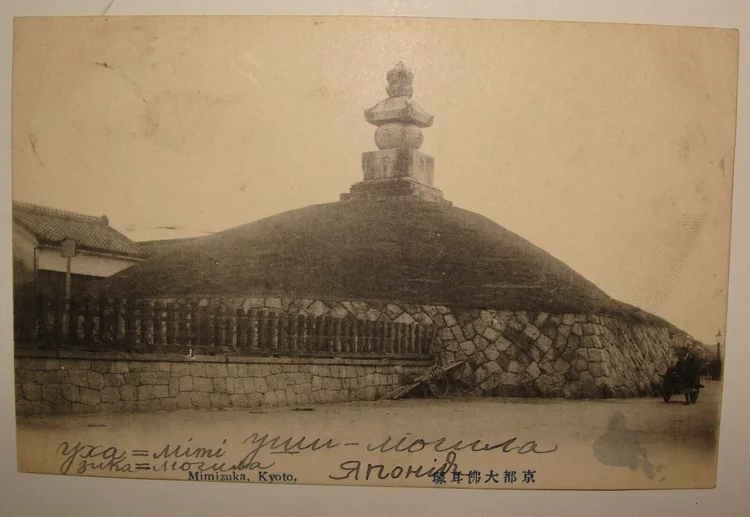
Collection #1: Noses Mimizuka comes up in my internet search for the word “trophy.” Translated from Japanese, Mimizuka means “ear mound” and is located in Kyoto, Japan. I’ve never been there, so my imagination has plenty of space to conjure WHATEVER, like a Lynchian pile of ears at various stages of rot. Critters crawling akimbo through detached channels, munching on lopsided lobes, depositing eggs near ruptured drums— Google Images interrupts. Like bleach to mold, a quick search stops this decomposition from flowering full on in my brain—kills it, and corrects—the cacophonous pile supplanted with the following collection: |
|
|
|
|
Virtual postcards laid out neat and tidy in a grid, as if to say, “No. No, Jenna, Mimizuka…Mimizuka looks like THIS.” Huh. Mimizuka—never been—looks placid, banal even, definitely not a teeming hoard of ears. So…where are they? Where are the ears? There are none. The mound, initially named Hanazuka, is composed of noses. Prior to the Japanese invasion of Korea between 1592 and 1598, soldiers were paid renumeration based on the number of severed heads they submitted to collection stations, where inspectors meticulously counted, recorded, salted and packed them. But the Japanese killed too many Koreans (and Chinese), and the ships were too crowded to carry so many heads, so they chopped off the noses and pickled them instead. The noses were brought back as trophies, relabeled “ears” (at the suggestion of some philosopher who thought ears less barbaric than noses) and buried in a mound. |
|
|
|
|
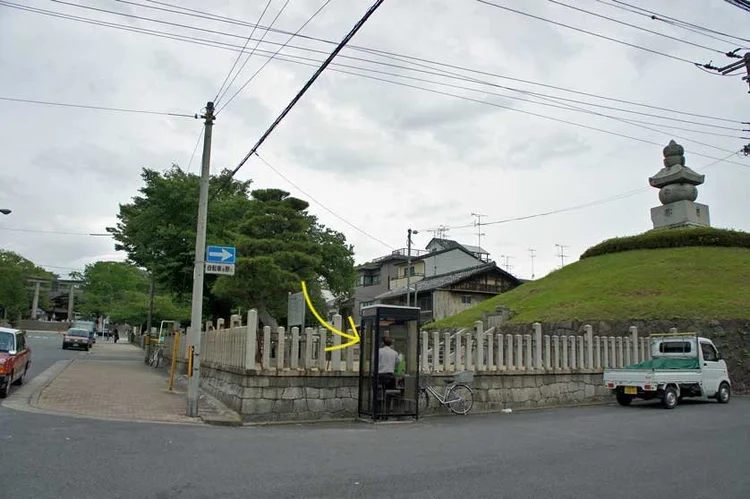
The description that accompanies this photo of Mimizuka on japan-experience.com doesn’t mention the telephone booth, nor the person inside—their own ear pressed against the receiver, listening to…a grandmother asking for a maneki-neko? An older brother insisting, yes, yes, he is well, he promises this will be the last time he asks for 40,000 yen. Or, is it a dial tone, one long electronic note of 400 hz (different tones in different countries) over which this person recites the names of the Koreans and Chinese whose noses are interred fifteen feet away from them? xoxo |
|
|
|
|
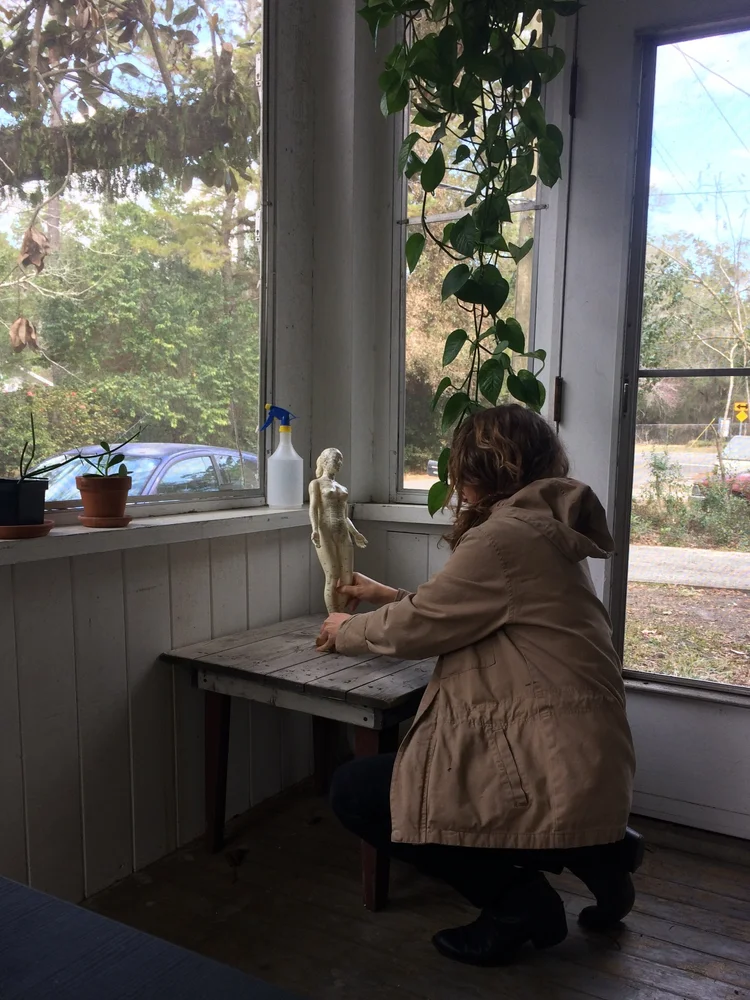
Collection #2: Statues of Men In February of 2018, I’m taking long bike rides through unfamiliar Floridian forests—big oaks decorated in loose boas of moss— trying to figure out how to start writing my tour (what became The Detour in 2019, which later morphed into Image Nation in 2022). I’m visiting a friend starting acupuncture school in Gainesville. When I snap this photo, she’s adjusting a newly inherited model, trying to get it to stand, suspended in muggy air on the porch. She turns around and asks, |
|
|
|
“So, what’s the tour gonna be about?” “Bubblegum” I reply, in upspeak. *Blink**Blink* It doesn’t stick. I clear my throat. “Uh, I just want to know, you know, like, why don’t mushrooms individuate heroically?” |
|
|
|
|
|
I’m pretty sure this question, to this day, is still the best summation of what I’ve been wrestling with for the last five years, if not more. Honestly, I don’t really know whether mushrooms individuate or not, and obviously they do to some extent (lions mane, shiitake, oyster…etc etc…right, like they have their own, distinctive characteristics), but mushrooms don’t go around building inert statues of themselves on pedestals surrounded by empty space. I returned to Philadelphia’s concrete metropolis and began to devote inordinate heaps of time to statues of founding fathers installed in the eighties. Most of them crappy. I made an entire show around one of them.
|
|
|
|
And there are plenty more—men, I mean. White men from the 1800s, white men from the 1900s, white men in bronze, white men in stone, all over Philadelphia. I’ve been in a long-term partnership with them—thinking about them, visiting them, working with them. I like to say, “I can’t get away” because it’s dramatic, but really, it was my choice to pay attention to them in the first place. Right? |
|
|
|
|
In 2021, I wrote copy for most statues or monuments along the parkway. Most group activities, like the student walk out of 1967, The Million Woman March, are designated with 2D historical markers, if at all. There’s one single non-allegorical, non-fictional 3-D representation of a woman along the entire parkway and she’s white: Joan of Arc, and she looks like a glorified, gargantuan sports trophy. The call for artists to design a permanent statue of Harriet Tubman just closed a few weeks ago; it will be the first statue of an African American historic female figure in the City’s public art collection. (Kindred Arts and Monument Lab have also recently installed multiple temporary monuments.) |
|
|
|
|
Million Woman March, 1997 |
|
|
|
|
Joan of Arc, located two blocks from where I buy groceries. There are, of course, thousands of living people along the parkway, but we’re talking about THINGS that are DEAD. Can you hunt a thing that is dead? No. But you can collect it. xoxo |
|
|
|
|
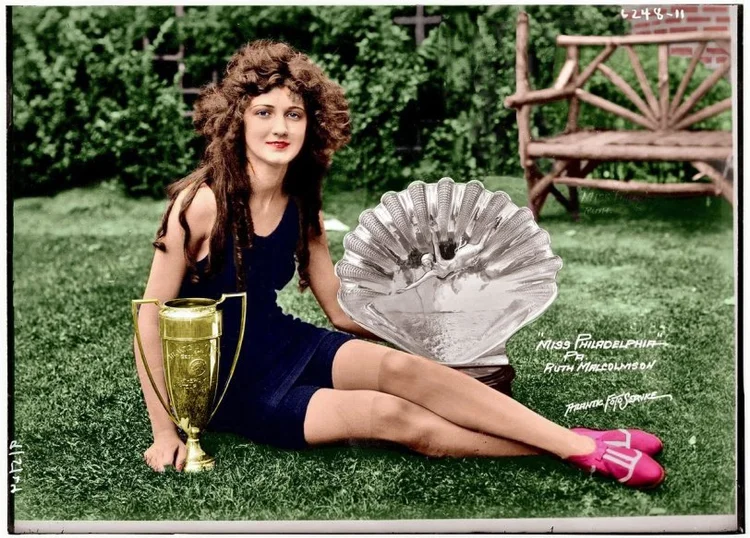
Eighteen-year-old Ruth Malcomson, Miss Philadelphia of 1924.
Atlantic Foto Service/George Grantham Bain Collection, colorized |
|
|
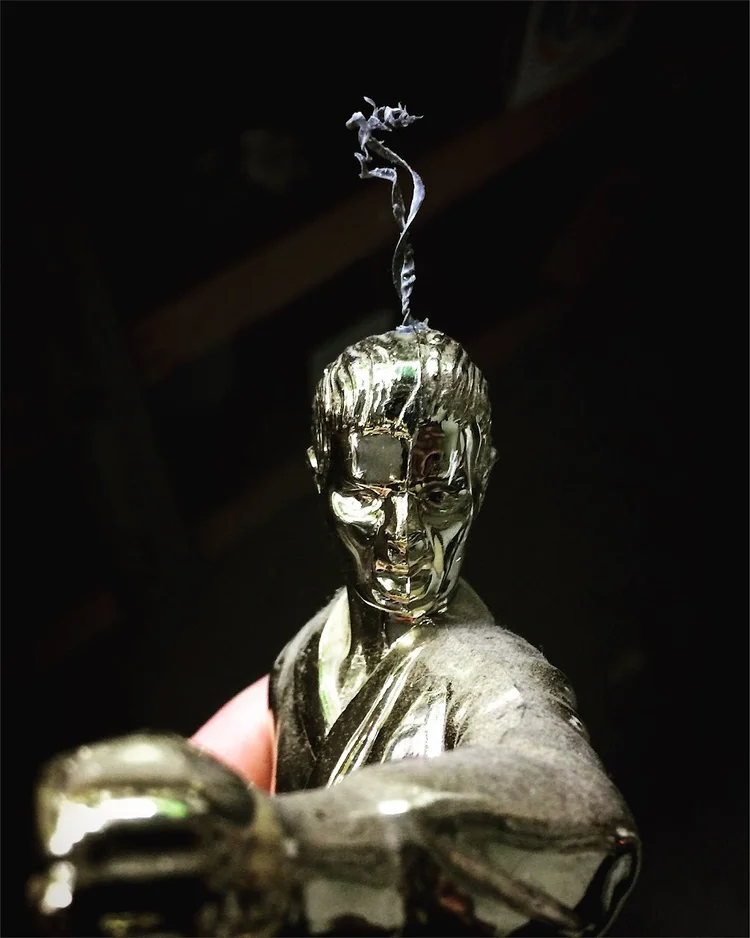
Collection #3: Sports Trophies I start collecting sports trophies in 2018. I call myself a “trophy wife,” but inverted; I’m not the object, I’m the collector. My friend Clancy swings by in his Volvo to drop off a load from a former karate studio. My friend Makoto leaves a bunch as an opening night present. I pick up a few from a Philly Aids Thrift. Facebook acquaintances pass theirs on—the majority of them demoted from the mantle long ago, but somehow not yet in a pile at the dump. Turns out most trophies come from one place: parents’ basements. And they are always dusty. I lug them everywhere—bowling, tennis, gymnastics, you name it. I can explain the whole regalia about as well as a bowerbird can explain their mating dance (and maybe why is the wrong question, anyhow). I cannot quell the urge to amass a hoard big enough to engulf one of these inanimate white men.
|
|
|
|
|
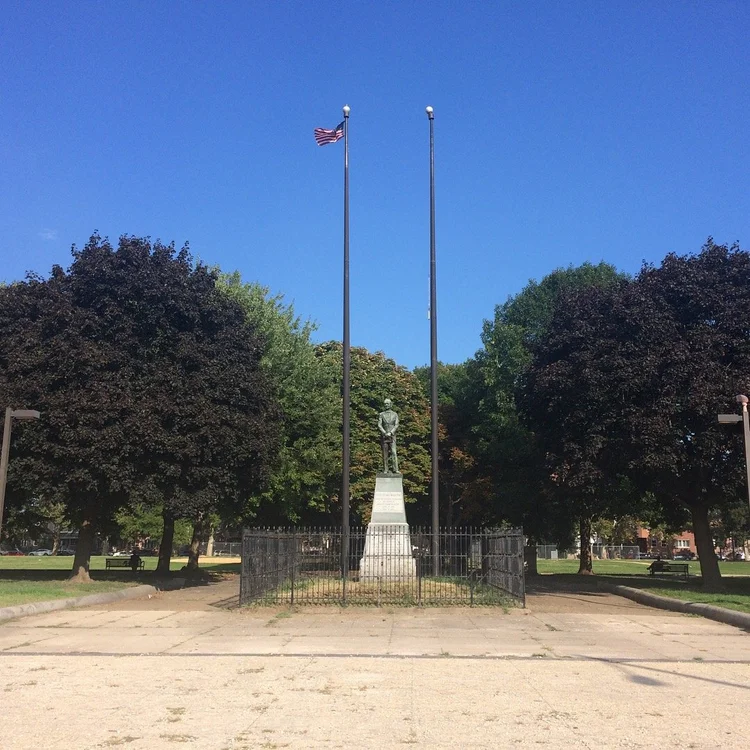
I have a particular one in mind—George Cylmer, in bronze. He’s installed at 5th and Chestnut; I used to see him at least three times daily when I was a tour guide. There’s a particular quality to him, the statue I mean: no one knows (or really cares) who George Clymer was. So much so that he’s named The Signer—a symbol, standing for WHITE MAN WITH PEN. The statue, while not shellacked gold like John of Arc, has strong sports trophy vibes. A kind of generic, wildly unspecific “heroism,” bereft of any specific energetic charge an icon like Rizzo or Columbus carries. There he is, taking up space, just not in your parents’ basement. But what if he were charged? Like, with an actual magnetic force, pulling all propagations of generic heroic individualism toward him? Imagine: sports trophies everywhere levitating from mantles, parents’ basements, school display cases, and coagulating around the statue in a weird apocalyptic storm. The mass engulfs him—something akin to the imagined pile of ears, but without the smell, and it sounds like this. I figured out—about 300 sports trophies in—that if I actually intended to manifest this weird fever dream, I would spend the rest of my life collecting these tiny little shitty statues, to which I said, “fuck that.” So I went to my friend Jeremy, who’s an animator, and he 3D scanned everything I had already built, and we made a monument. You can’t see George Clymer, but he’s in there. I sent you a postcard. Did you get it? |
|
|
|
|
xoxo ____________________________________________ |
|
|
|
|
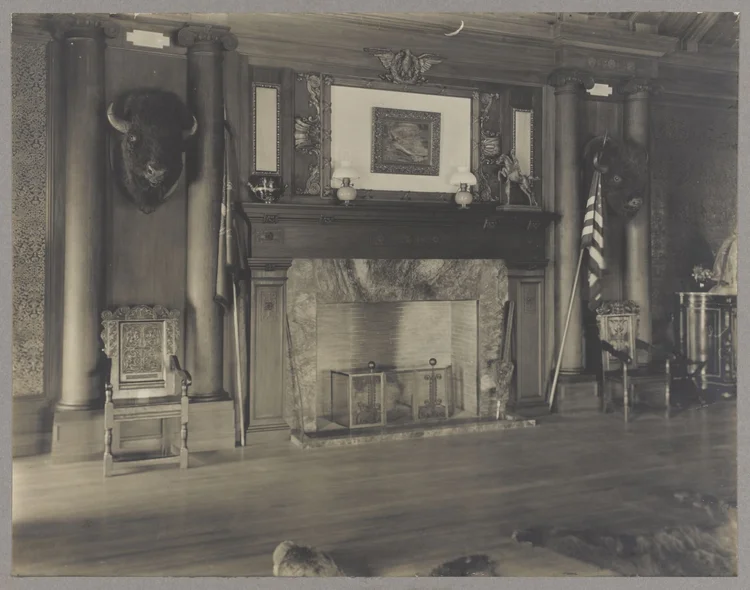
Theodore Roosevelt’s Trophy Room at Sagamore Hill, in Oyster Bay, NY.
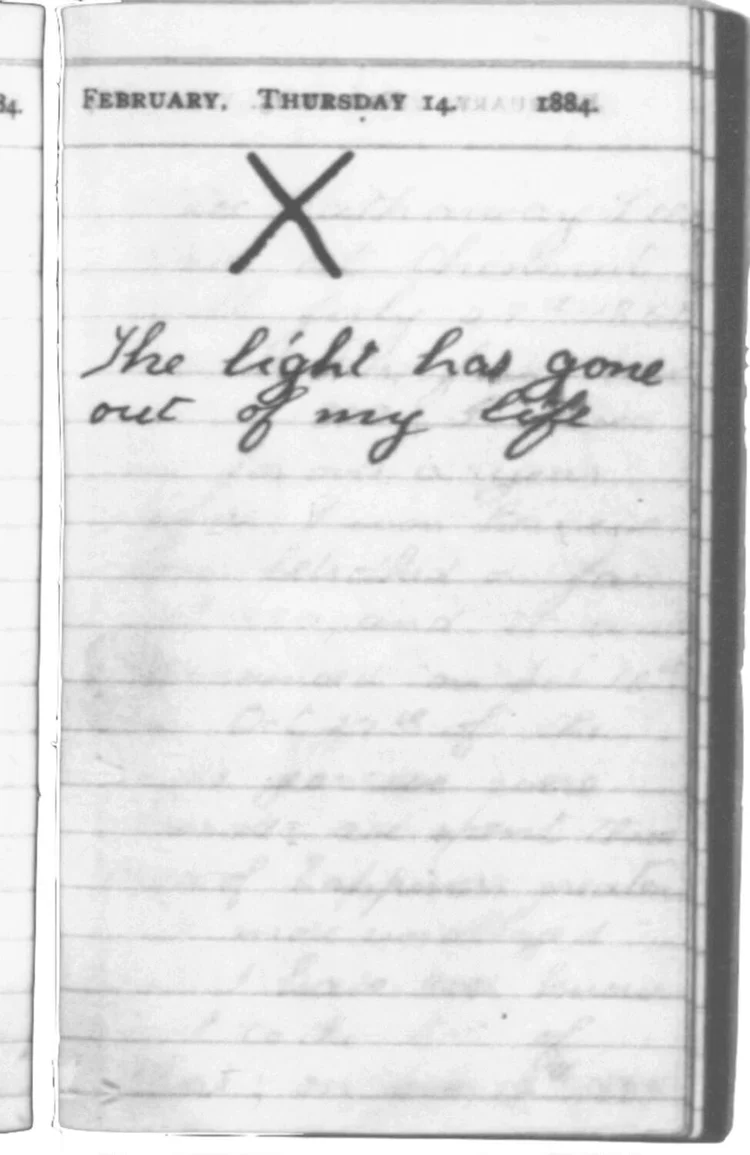
Collection #4: X’s In 1883 Theodore Roosevelt killed his first bison at Little Cannonball Creek. Allegedly, he danced enthusiastically around the bison to celebrate the kill (in fact, may have performed a racist version of his idea of some generalized Native American dance). Roosevelt thought of the American bison, the largest land mammal on the continent, as a symbol—of “wild nature” and “western culture.” After two weeks in the Dakotas, he left with a bison head, his only goal during the short visit, and a cattle ranching operation to boot. On Valentine’s Day of the following year, 1884, he wrote one sentence in his diary: “X. The light has gone out of my life.” |
|
|
On that same day, Roosevelt lost his mother Martha to typhoid at 3 a.m. and his wife Alice, who’d given birth two days prior, to a kidney disease at 2 p.m. The couple had announced their engagement exactly four years prior. After Alice’s death, he never spoke her name, destroyed all correspondence that made reference to her, and left his newborn daughter—baptized Alice—in his sister’s care, and left for the newly named “Dakota Territories,” where the People of the Seven Council Fires had been actively resisting the encroaching US government. |
|
|
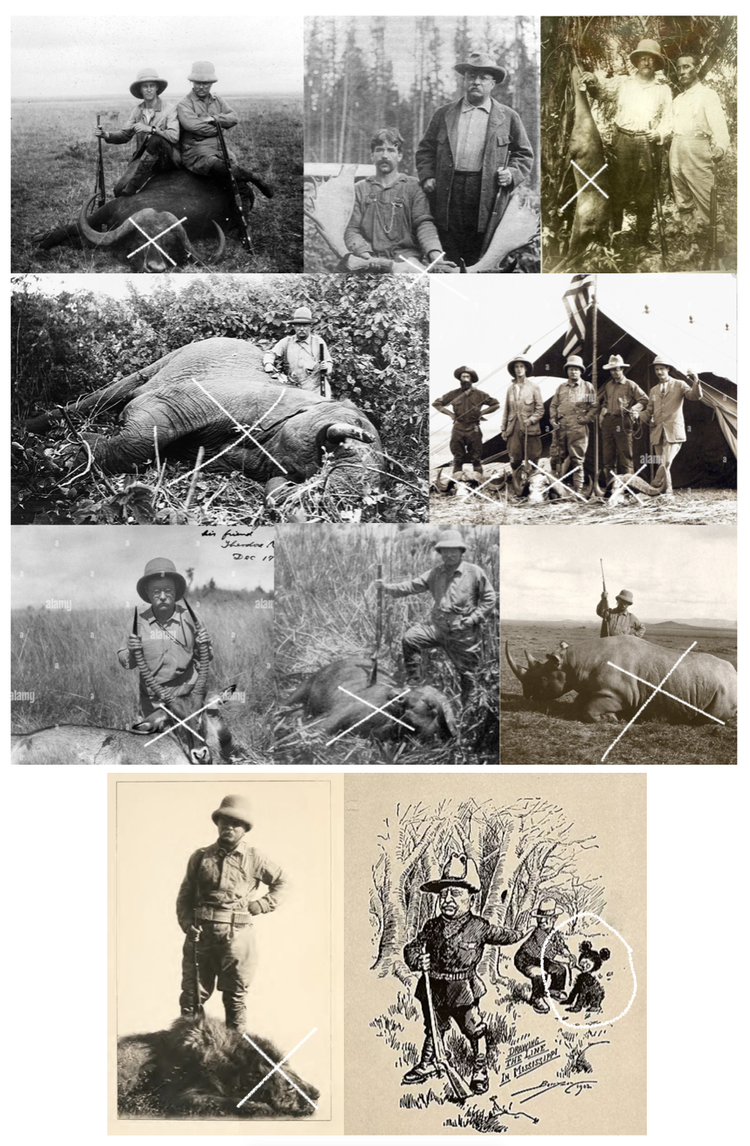
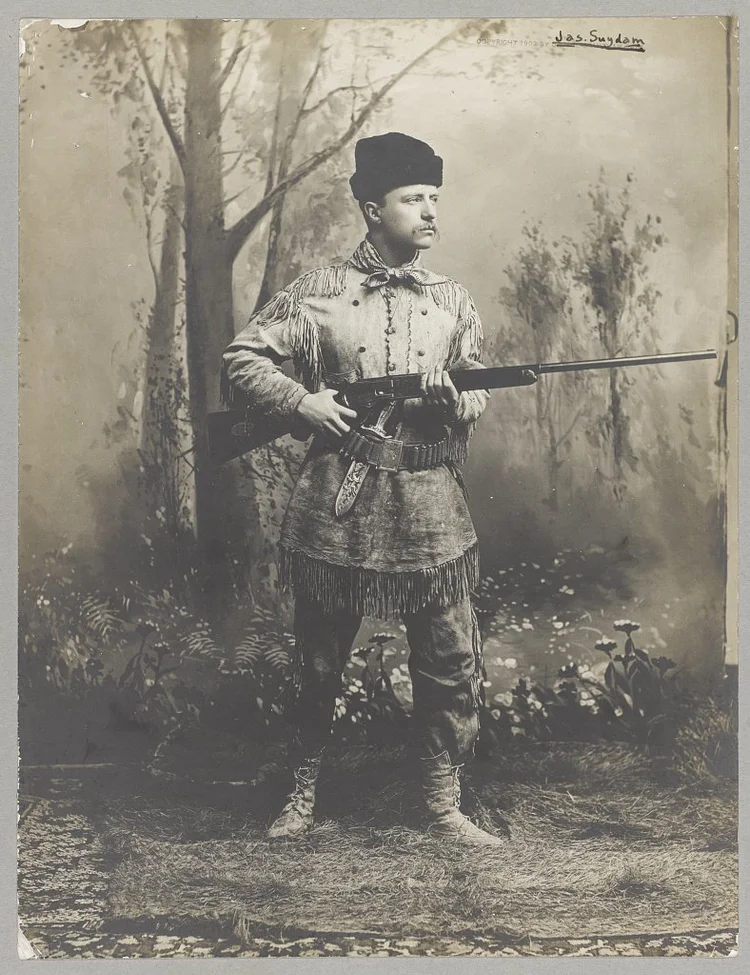
A year later, Roosevelt posed with moccasins, rifle, and sheath knife, for this photo—used to promote his 1885 book Hunting Trips of a Ranchman. You can see the carpet beneath the staged grass. Weirdly enough, TIME describes this photo as an icon of the conservation movement, while an article published by the Scientific American crowns Roosevelt as “the president who saved the American bison.” Below, I include a small and non-comprehensive collection of Roosevelt hunting photos, posing with his “trophies” over the course of his life. |
|
|
|
|
|
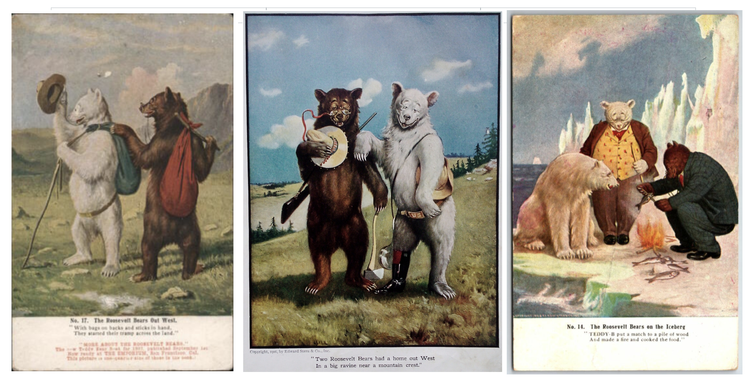
This last one, an exception to the motif, is Clifford Barryman’s cartoon, which appeared in the Washington Post on November 16, 1902, and lampoons a bear hunt where Roosevelt’s assistants tied a bear up to a tree so he could shoot it. He refused, saying it would be unsportsmanlike. Maybe you were already onto this, but I was thirty-seven-years-old when I realized this whole chain of events, plus a Brooklyn candy store owner with an idea to capitalize, led up to the creation of “Teddy’s Bear.” |
|
|
|
A Valentine’s Day pair, Teddy-B and Teddy-G, from a series created by Seymour Eaton in the early 1900s. From left to right: No. 1 The Roosevelt Bears at Home, No 17. The Roosevelt Bears Out West, No. 14 The Roosevelt Bears on the Iceberg. |
|
|
|
|
xoxo _____________________________________________ |
|
|
|
|
|
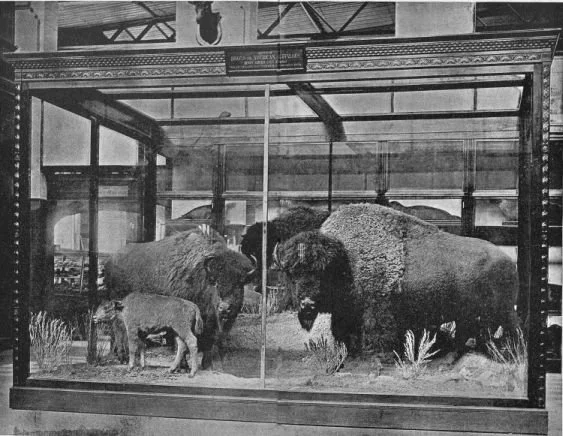
Group of American Bisons in the National Museum.
Collected and mounted by W. T. Hornaday. Collection #5: Bison The first time I encountered a bison—alive or dead? If alive, from my family’s blue minivan on some highway (1-70?) in Colorado; if dead, from behind glass at the Denver Museum of Nature and Science. I might have been, oh, eight years old. When I leaned over the railing to get closer to the diorama, I had no idea the bison, the first mammal recorded in the museum’s catalogue, came from Edwin Carter. Before dying of arsenic poisoning, he lived in Breckenridge in a cabin with his collection of what become over 3,000 taxidermied animals. He’d gone out there during the gold rush, saw the destruction of the mining and logging industries in the Rocky Mountains and pivoted to “preserve” the local wildlife. His collection became foundational to the museum my brother and I frequented as kids in the 90s. His cabin is now called a “discovery center.” |
|
|
|
Child (perhaps, oh, eight years old) poses for a portrait in front of a backdrop at the Buffalo Bill Museum. Not me, but could be.
(Year unknown. 1994? Why not.) |
|
|
|
|
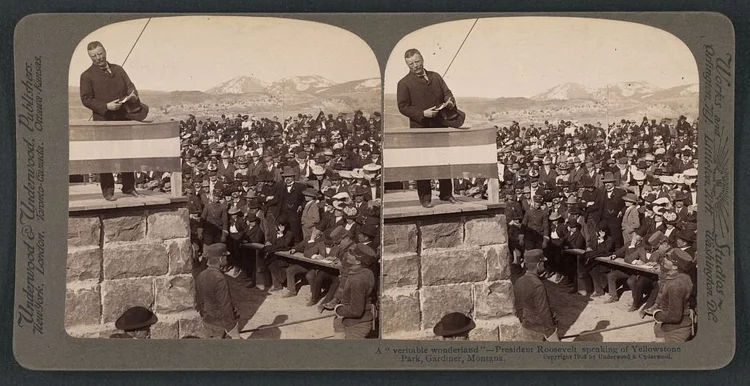
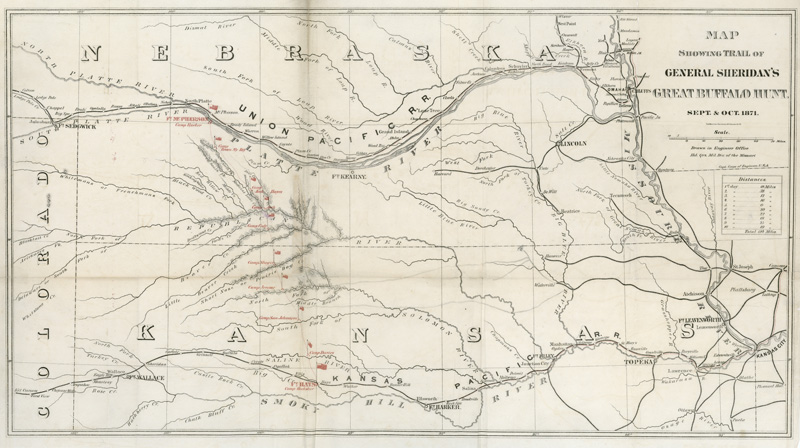
US Army men (none of whom are Teddy Roosevelt, but could be) pose with eight bison heads, confiscated from notorious poacher Ed Howell. Photo taken in 1894 by Yellowstone’s resident photographer, F Jay Haynes. When Yellowstone was “discovered” in 1870, the Eastern and Northern Shoshone, along with multiple other tribes, had inherited, maintained, and used the landscape for thousands of years. The area was ”set apart as a public park or pleasuring ground for the benefit and enjoyment of the people” and designated “unoccupied land of the United States” on March 1, 1872. A line is easy enough to draw on a paper map; drawing one in real life however —foaming, fermenting, fraught, freezing, fertile—can be harder, though it hasn’t stopped nations (and people) from trying (ie wall, wall, wall, wall, wall, wall?). The Crow still considered it their homeland and occupied the area generally east; the Umatilla occupied areas to the north. The Shoshone, Bannock, and other tribes of the plateaus to the west traversed the park annually to hunt on the plains to the east. Other Blackfeet groups hunted in open areas west and south. Groups from the Fort Hall and Lehmi reservations maintained favored campsites and hunting areas through the use of seasonal burns. Specific treaties ceding land to the US government were made with the explicit guarantee that tribal members had “the right to hunt on the unoccupied land of the United States so long as game may be found thereon.” Deer and mountain sheep remained plentiful through the late nineteenth century. With the bison, it was a different story. Within the two years between “discovery” and “park”, Teddy Roosevelt became a teenager and received his first gun and first pair of eyeglasses (another gun of his, a collectible Smith and Wesson recently sold at auction for nearly one million dollars in December 2022). In 1871, “Buffalo Bill” Cody served as guide for General Sheridan’s “Great Buffalo Hunt,” and Edward F. Gorton (or Horton, may you take neither at face value) served as writer. “The buffalo hunter always secures the tail of the buffalo he has killed as the Indian does the scalp of the enemy he has overcome to prove to the world the fact of his success” ( Ten Days on The Plains). The bison population was estimated around 10 million. When Theodore visited the “veritable wonderland”on a presidential tour about thirty years later in 1903, the bison herd at Yellowstone numbered somewhere around 24. |
|
|
|
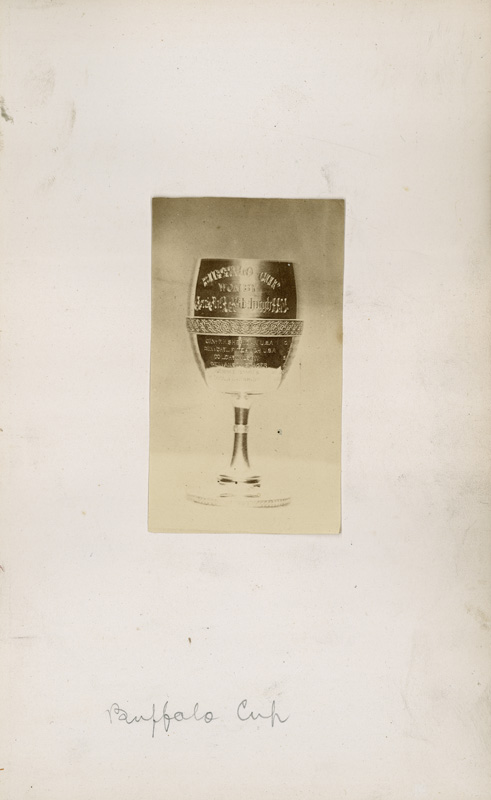
Buffalo Cup. Those in Sheridan’s hunting group agreed they should all go in on buying two cups, one to be rewarded to whomever brought down the first buffalo and the other to whomever shot down the first elk. |
|
|
|
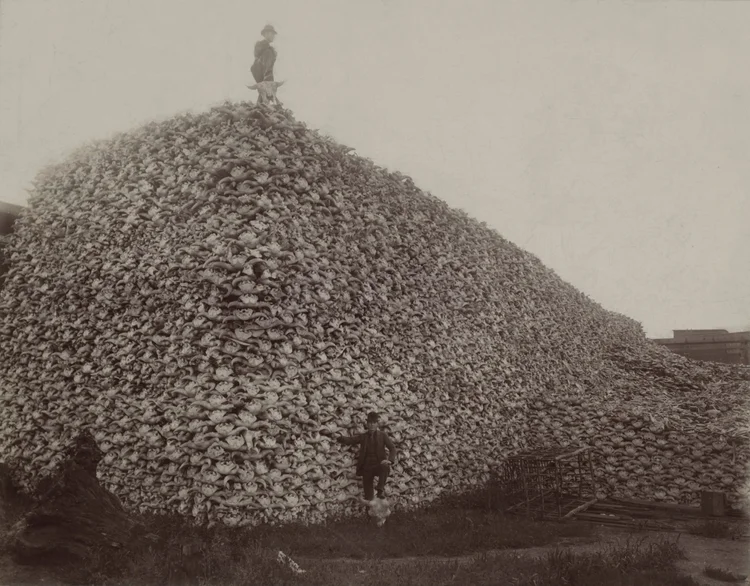
This photograph, taken outside of Michigan Carbon Works in Rougeville, Mich. in 1892, became iconic for the bison extermination in the 1870s. With carcasses left behind (hides, tongues, and heads taken), a whole trade and market emerged around bison bones, which were gathered from the plains, shipped on trains, and used in refining sugar, making fertilizer and fine bone china. |
|
|
|
Teddy (alive) and president, on a plinth. He’s giving a speech commemorating the 'laying of the cornerstone' of the road that would lead to the entrance of Yellowstone National Park. |
|
|
|
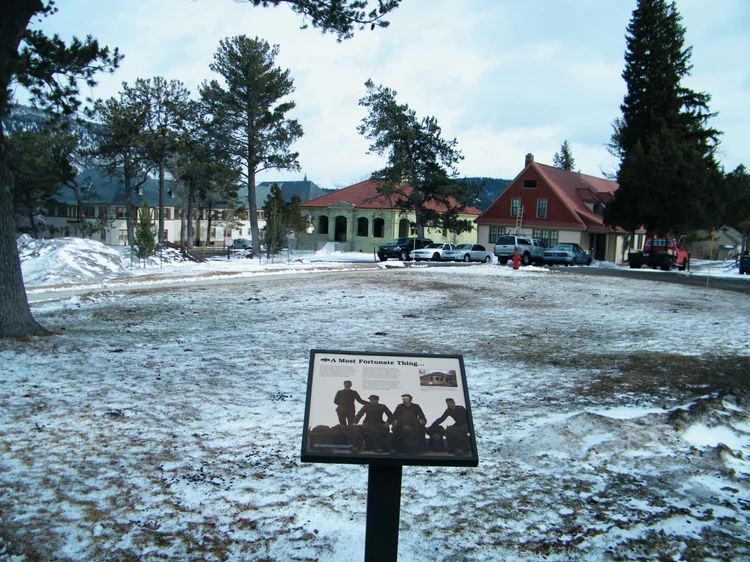
Here’s that photo again, in the foreground—without my x’s— on former historical marker in Yellowstone. The plaque narrates, “before the Army arrived, the park's future was in doubt. Vandals destroyed thermal features, squatters sawed down trees and poachers decimated herds of wildlife. Perhaps the Army's greatest contribution to Yellowstone's history was bringing law and order to the park.” Like the plaque itself, standing isolated and contextless in the middle of empty space, these three sentences make for a simple story located in one spot —beginning: BEFORE US, middle: DANGER, and end: SETTLED. Within one tidy square, the army becomes protector, as if to say, “No, Jenna. No, law and order look like this.” _________(Instagram, museums, plaques, plinths, gallery podiums, Marie Kondo, minimalism, western thought, fill in the blank…) might train anyone, over and over, to believe a story exists in a singular, disassociated frame. Meanwhile, its context, realities, violences, fantasies, histories, allegiances—the sticky bramble of association—exists and fractures outward. |
|
|
|
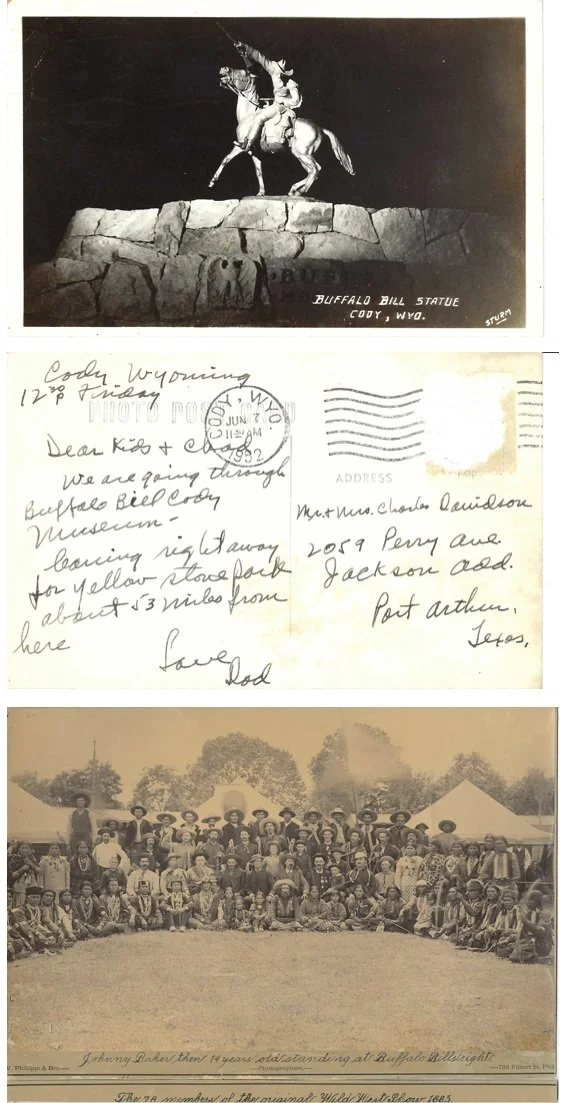
1. A statue of “Buffalo Bill” Cody surrounded by the fallacy of empty space.
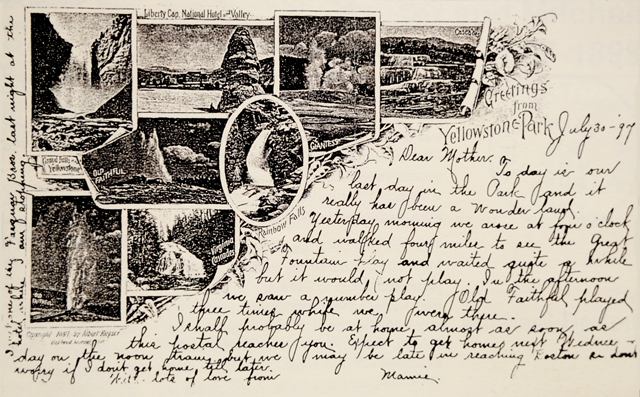
2. The back of the postcard featuring the statue.
3. A photo (taken or produced on Filbert St in Philadelphia) of William Frederick Cody and the 78 Members of the Original Wild West Show, 1883 . General Sheridan was a huge proponent of resourcing Yellowstone’s initially underfunded management, and in particular, the military installation; in case you forgot, Sheridan was the guy who organized the Great Buffalo Hunt in 1871, facilitated by, yup, “Buffalo Bill” Cody. Four years later, Sheridan may or may not have made an appearance at the Texas state legislature where a bill to protect the bison was up for consideration. Multiple websites don’t reference it, but use a quote from The Border And The Buffalo by John R. Cook, who describes Sheridan telling the assembly, they were making a sentimental mistake by legislating in the interest of the buffalo…instead of stopping the hunters they ought to give them a hearty, unanimous vote of thanks, and appropriate a sufficient sum of money to strike and present to each one a medal of bronze, with a dead buffalo on one side and a discouraged Indian on the other.
Another head, another token. Adam Khalil, skeptical of documentary’s relationship to truth, has been working with another iteration of “the discouraged Indian” in bronze; it’s not the medal Sheridan called for, but a statue made by James Earle Fraser, called “The End of the Trail,” which some call an American icon. (What if I stopped collecting?) I’m unclear whether Sheridan organized his Great Buffalo Hunt after receiving William Tecumseh Sherman’s missive saying, “ I think it would be wise to invite all the sportsmen … there this fall for a Grand Buffalo hunt, and make one grand sweep of them all. Until the Buffalo and consequent Indians are out [from between] the Roads we will have collisions and trouble” (Sheridan Papers, 1868). (Would everything spin out of control?) Regardless, Sheridan took over Sherman’s job as General-in-Chief of the U.S. Army, tasked to protect the transcontinental railroad and secure mining interest in territory traditionally owned and settled by Native Americans, especially the Nations of the Great Plains. The U.S. Army strategically supported the large scale destruction of the bison, knowing of the animal’s central role in indigenous cultures across the Plains, knowing its loss would weaken their ability to resist removal—forced, negotiated or otherwise. |
|
|
|
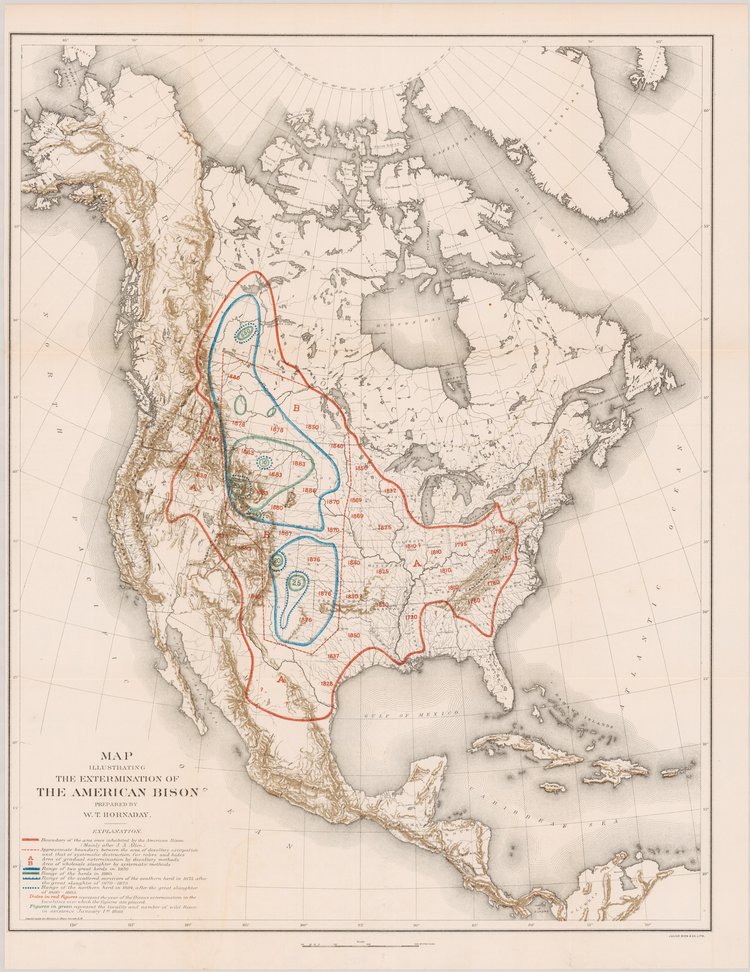
“Map Illustrating The Extermination of The American Bison” made by W. T. Hornaday, who worked for the Smithsonian, and made the display of bison you saw at the beginning of this section. (No, no, no. I can’t. I won’t. They are, who am I — I AM NOT A MUSHROOM, GET BACK!) After traveling through Yellowstone in the summers of 1881 and 1882, General Sheridan complained about the park’s inadequacy as a game preserve. He appealed to eastern sportsmen (perhaps those that had attended the hunt?) and asked them to push Congress to authorize the secretary of War to dispatch “the necessary details of troops to prevent…{destruction] of the game or objects of curiosity” in the park. The military took over complete management of the park in 1886. Eight years later, four soldiers posed with bison heads for the photo in 1894 that “saved America’s iconic mammal.” (I will die without these THINGS. No, I cannot… Die! I! My THINGS! I, them, I like them, they are, like, me. DON’T TOUCH ME. [I will die!] No, did you see this next THING?) |
|
|
|
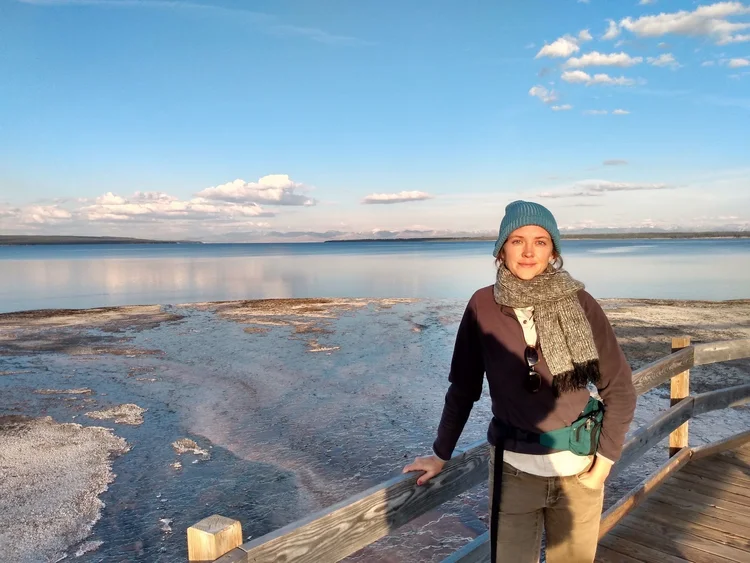
Me posing for a portrait in front of West Thumb, Yellowstone Lake in 2021, one of the 4.86 million visits recorded at the park that year. Gotta catch ‘em all!
Fixated and yours,
xoxo,
A collector/A collectible
P.S.
A note on value (and possession).
Despite the rewrite to “The Giving Tree” having an internet moment, and the obvious wisdom of “value your time",” “guard your time,” “protect your time,” I give these missives my time and energy because they bring me satisfaction, challenge, and inner nourishment. I am not fooled, or I’m a wholehearted one; these are profoundly inefficient and, for me, a worthwhile offering. If and when that shifts, I won’t send them. If supporting these “newsletters” (hah, hardly) with money would feel good to you (many have inquired) the door’s open.
My Venmo is Jay_Ho. Transaction and property are real,
but so are gifts. P.P.S.
I really tried to get this out in time for Valentine’s Day,
but I’m not Hallmark. P.P.P.S. Collection #1
Collection #2
Collection #3 |
|
|
|
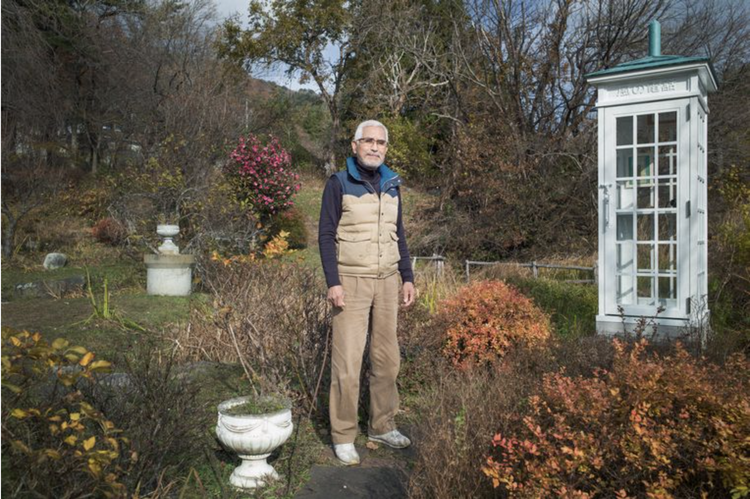
Itaru Sasaki stands in his garden in Ōtsuchi, Iwate Prefecture, Japan. When Itaru lost his cousin in 2010, he longed for a way to stay connected to him while grieving. He bought an old-fashioned, green-roofed, glass-paneled telephone both and put it in his garden. Inside there is a little shelf with a notebook and pen, several small decorations, and a black rotary telephone. The telephone has no electricity, is connected to nowhere, and does not ring. Itaru did not know how to speak about his grief or to whom; he was hoping for the wind to somehow carry his words to his cousin so he named it “Kaze No Denwa” or Telephone of the Wind. |
|
|
|
|